

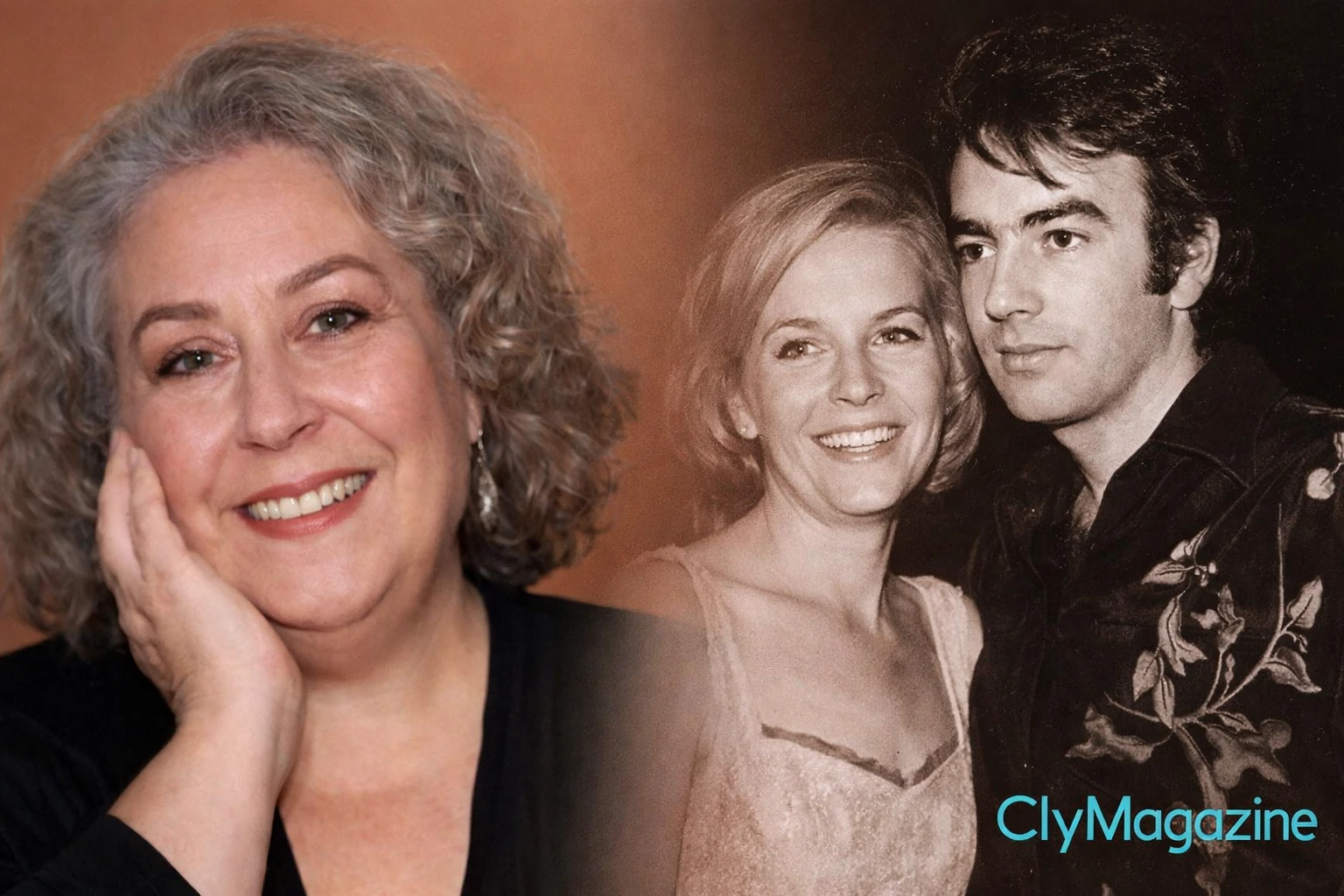
| Attribute | Details |
|---|---|
| Full Name | Best-supported public spelling: Jaye Posner; widely searched as Jayne Posner |
| Date of Birth | Not publicly verified |
| Age | Not publicly verified (as of 2026) |
| Place of Birth | Not publicly verified |
| Nationality | Not publicly verified in high-quality public sources |
| Profession | Private individual; often described in secondary sources as a schoolteacher |
| Famous For | Being Neil Diamond’s first wife and the mother of his daughters Marjorie and Elyn |
| Marital Status | Divorced from Neil Diamond in 1969; later status not publicly verified |
| Children | Two daughters, Marjorie and Elyn |
| Estimated Net Worth | $Unknown; no credible public estimate (as of 2026) |
Jayne Posner occupies a strange place in celebrity history. She is often searched by name, often summarized in thin online biographies, and yet the strongest public record shows a far more private figure than the internet usually admits. What can be said with confidence is both simpler and more human: she was Neil Diamond’s first wife, the mother of his first two children, and part of the early family life that existed before his fame hardened into legend.
Even her name points to the problem. Many web pages call her Jayne Posner, but stronger sources, including People’s 2026 retrospective on Neil Diamond and official material tied to the Broadway musical A Beautiful Noise, use the spelling Jaye Posner. That does not settle every question about her life, though it does show how easily a private person can be flattened into a repeated fact pattern that grows less reliable with each retelling.
That gap between public curiosity and verified detail is what makes Posner worth understanding. Her life, at least in public view, was never built for celebrity coverage. It survives in fragments: a marriage in 1963, two daughters, a divorce in 1969, and later reflections from Diamond about how the demands of his career strained that first family life.
Early Life and Family
The hardest part of writing about Jayne Posner is the part most biography readers expect first. There is no strong public source that firmly establishes her date of birth, birthplace, parents, siblings, or childhood story. Plenty of low-grade biography sites offer those details with great confidence, but they rarely show where the information comes from, and the claims tend to echo one another rather than lead back to a solid record.
That means any careful portrait has to start with restraint. The safest account is that Posner belonged to Neil Diamond’s early world, before he became an international music star, and that their relationship began when both were young. Beyond that, the public record grows thin very quickly, and a responsible biography has to say so rather than fill the silence with borrowed certainty.
Her schooling is a similar case. Some secondary profiles place both Posner and Diamond in the same Brooklyn orbit and attach specific schools to that story, but the higher-quality sourcing available in public does not confirm those details well enough to repeat them as fact. In a life story shaped by privacy, silence can be more truthful than decoration.
Her Place in Neil Diamond’s Early Life
If Posner remains hard to see directly, she appears more clearly in the story told around Neil Diamond’s rise. According to later retellings of Diamond’s own recollections, he wrote the song “Hear Them Bells” as a teenager for the girl who would become his first wife. That anecdote should be treated carefully, because it comes through remembered commentary rather than a contemporaneous record, but it does suggest how early and how personally entwined their relationship may have been.
The marriage itself is firmly documented. People reported in 2026 that Diamond married Jaye Posner in 1963, years before the peak of his fame, and that the couple later had two daughters, Marjorie and Elyn. Those facts form the strongest center of Posner’s public biography, because they are tied to the family structure Diamond himself acknowledged over the years.
This is also where her story starts to matter beyond celebrity trivia. Posner was not just a footnote in the life of a famous singer; she was part of the domestic world that existed while his career was still becoming what it would be. That context gives her story weight, even if the record never opens wide enough to offer the kind of detailed personal archive readers may wish existed.
Career and Work
Posner’s own professional life is harder to pin down than her marriage. A number of secondary sources describe her as a schoolteacher or educator, and that description may well be true, but it is not strongly anchored in primary documentation or in major reported profiles. The honest way to handle that claim is to present it as a repeated public description rather than a settled fact.
That distinction matters because private women connected to famous men are often assigned tidy labels that sound plausible and then harden into biography shorthand. In Posner’s case, the available evidence supports her role in Diamond’s early family life much more clearly than it supports a full account of her career. A strong article has to respect that difference and resist making her seem more publicly documented than she is.
Even so, the fragments carry meaning. The image that emerges is not of someone chasing public attention, but of someone who remained outside the machinery of fame even while living close to it. That may be one reason why so many later accounts about her feel more like copies of copies than reporting.
Marriage, Children, and Family Life
The clearest personal facts about Posner are also the most important. She married Neil Diamond in 1963, and together they had two daughters, Marjorie and Elyn. Their marriage ended in divorce in 1969, and that timeline is one of the few parts of her biography that can be stated without hesitation.
What the public knows about the emotional life of that marriage comes mostly from Diamond’s later reflections rather than from Posner herself. In a 2011 interview with The Independent, Diamond said the work that drove his success also kept him away from Posner and their daughters for long stretches. He described the repeated departures and the sadness around them in a way that suggests regret was still close at hand decades later.
That interview offers one of the rare moments where Posner’s life comes into focus not as gossip, but as lived consequence. Diamond said he had been writing, recording, and performing nonstop, and that the burden of those absences damaged his first family life. It is a more grounded explanation than the speculative stories that often gather around celebrity divorces, and it gives the marriage a real human scale.
There is another revealing thread in Diamond’s later comments. He said that after building a second family, he kept traveling east to see his daughters, trying to remain present in their lives despite the damage already done by distance. In that way, Posner’s biography also becomes part of a wider story about ambition, family cost, and the long afterlife of early choices.
People’s 2026 retrospective adds another useful detail to that family picture. It recalled Diamond’s older belief that the best thing he could give his children was “a normal life,” a phrase that helps explain why so little public material exists about Posner and the daughters they shared. Privacy, in this case, was not an accident of bad record-keeping; it seems to have been a conscious family boundary.
Divorce and the Shape of Public Memory
Posner and Diamond divorced in 1969, and the timing matters. By then, Diamond’s career was gathering force, and his public identity was becoming much larger than the intimate life that had helped frame his early years. Soon after the divorce, he married Marcia Murphey, beginning the next chapter of a life that would remain far more documented than Posner’s own.
This is where many online biographies go wrong. Instead of staying with the facts, they turn the first marriage into a stock rise-and-fall story, often adding motives, betrayals, or emotional details that are not well sourced. The stronger public record is quieter than that, and for that reason it is also more convincing.
What remains after the noise is a picture of a woman who disappears from view not because she lacked importance, but because she did not build a public persona from her connection to fame. That is a meaningful distinction. In many celebrity biographies, the least visible people are often the ones who absorbed the most change without ever being invited to narrate it themselves.
Why Jayne Posner Is Still Searched Today
Posner’s name still circulates because Neil Diamond’s life remains culturally active. A Beautiful Noise, the authorized Broadway musical based on his life and music, brought renewed attention to the people who shaped his early years. In official materials tied to the production, the character is named Jaye Posner, which is one of the strongest present-day confirmations of the spelling attached to her.
That detail matters for more than search accuracy. It shows that Posner is not just a buried name in old fan histories; she is part of Diamond’s authorized life story as it is presented to new audiences. When Diamond told CBS in 2023 that the musical had to be “warts and all,” he signaled that the first marriage belonged in the story honestly, not as a polished omission.
The musical does not solve the historical gaps around Posner’s life, but it does explain why interest in her has returned. Viewers hear her name, search for her biography, and run into a flood of confident claims that do not always hold up. That makes careful writing even more necessary, because the renewed attention is real even when the available evidence remains limited.
Net Worth, Public Claims, and the Problem of Thin Sourcing
One of the weakest parts of Posner’s online biography is the money section that so many websites insist on providing. Unsupported net worth estimates appear across celebrity blogs and profile aggregators, with figures that vary widely and rarely show any method behind them. There is no credible public estimate of Jayne or Jaye Posner’s personal net worth that can be treated as reliable as of 2026.
The same caution applies to business ventures, ownership stakes, endorsements, or any supposed financial settlement details. None of that is well documented in the stronger public sources. If money belongs in her biography at all, it belongs there as a warning about how the internet often mistakes the demand for a fact for proof that the fact exists.
This may sound like a small issue, yet it reveals something larger about how celebrity-adjacent biographies are built. Once a person becomes searchable, websites often force a standard template onto their life whether the evidence supports it or not. Posner’s story resists that template, and the resistance is part of what makes her biography more interesting than a pile of easy claims.
What Is Known About Her Life Now
The honest answer to the question of where Posner is now is that the stronger public record does not say. There are no widely reported 2024, 2025, or 2026 interviews, public appearances, or verified personal updates that place her in a current public role. That absence should not be treated as mystery for its own sake; it may simply reflect a life lived outside publicity.
What is current is the world around her story. Diamond remained visible in recent years through appearances connected to A Beautiful Noise, including a surprise 2025 performance of “Sweet Caroline,” and his official site announced the 2026 release of Wild At Heart. Those developments keep interest in his earlier life alive, and by extension they keep sending readers back toward Posner.
That return of attention has an odd effect. It makes Posner feel present in public conversation while leaving her personally out of reach. For a writer, that means the real task is not uncovering secrets that are not available, but drawing an honest line between what public culture wants from her story and what the record can actually sustain.
The Meaning of a Private Biography
There is a temptation to think a sparse public record produces a thin biography. In Posner’s case, the opposite can be true. Her life story, even in outline, raises questions about memory, early love, family cost, and the invisible labor of being near someone whose ambitions kept widening.
Some of the most telling details are also the least flashy. The spelling difference between Jayne and Jaye shows how easily a life can be blurred once it enters the copy-and-paste economy of online biography. Diamond’s later regret over time lost with Posner and their daughters gives the first marriage a depth that gossip never could.
Another small but telling fact is that Posner survives in public memory through an authorized stage production rather than through self-presentation. She is remembered because a larger life story keeps circling back to its beginnings. That gives her biography a quiet durability, even if many of its personal details remain unavailable.
Frequently Asked Questions
Who was Jayne Posner?
Jayne Posner, more strongly documented in some sources as Jaye Posner, was Neil Diamond’s first wife. She is publicly confirmed as the mother of his daughters Marjorie and Elyn, and she married Diamond in 1963 before their divorce in 1969. Beyond those family facts, much of her personal background remains private or weakly sourced in public records.
Is Jayne Posner the same person as Jaye Posner?
Yes, the available evidence points to Jayne Posner and Jaye Posner being the same person. The spelling “Jayne” is common in search results and on weak biography pages, while stronger sources such as People’s 2026 Neil Diamond retrospective and official material for A Beautiful Noise use “Jaye.” A careful article should acknowledge both spellings and explain that “Jaye” appears better supported in the public record.
What did Jayne Posner do for a living?
Public sources often describe Posner as a schoolteacher or educator, but that claim is not firmly backed by high-quality primary documentation. It may be accurate, yet the sourcing is too thin to present it as settled fact without caution. The safest phrasing is that she has frequently been described that way in secondary biographies.
Why did Jayne Posner and Neil Diamond divorce?
No strong source gives a full private account from Posner herself, so any simple answer would go too far. The most grounded public explanation comes from Diamond’s later comments, where he said his nonstop work as a writer, recording artist, and performer took a heavy toll on his first marriage and on family life with Posner and their daughters. That is more reliable than the speculative stories that often appear on celebrity websites.
What is Jayne Posner doing now?
There is no well-sourced public update that clearly states what Posner is doing now. She has not re-emerged as a public figure in the recent reporting tied to Neil Diamond’s life, and no verified 2024 to 2026 personal profile appears in the stronger public sources. Her continued visibility comes mostly from renewed interest in Diamond’s early life and from the Broadway musical A Beautiful Noise.
Conclusion
Jayne Posner’s biography is, in one sense, a story about limits. The public record does not open neatly around her, and that can frustrate readers trained by celebrity culture to expect every life to come with dates, milestones, and tidy personal detail. Yet the restraint her story requires is also what gives it integrity.
She matters not because the internet has built a large mythology around her, but because a few durable facts place her at the start of a very public life that later moved far beyond the private world where it began. She was there in the years before Neil Diamond’s legend fully took shape, and she remained part of the family story even after the marriage ended. That is enough to justify real attention, provided the attention is careful.
There is also something quietly moving about the way her life continues to surface. An authorized musical keeps her name in circulation, Diamond’s later interviews cast fresh light on the cost of those early years, and new audiences keep asking who she was. Each return to that question shows how often public memory depends on people who never chose public life for themselves.
What lasts, then, is not a pile of dramatic claims but a more grounded truth. Jayne, or Jaye, Posner remains a private figure whose place in history comes from the first family chapter of Neil Diamond’s life and from the daughters they shared. As long as that larger story keeps being told, her own small but lasting place within it will keep inviting a writer’s best habits: care, honesty, and respect for what the record can truly say.


